What Happens During a Physical Therapy Assessment
The first assessment provides a starting point for understanding a person's physical abilities and limitations. Depending on the condition, a physical therapist may examine joint range of motion, muscle strength, balance, gait, mobility, and functional activities. The assessment is not simply about identifying an abnormal measurement. The therapist also considers how a limitation affects activities that matter to the patient, such as walking, climbing stairs, dressing, working, or participating in hobbies. The American Physical Therapy Association recommends establishing baseline measurements that can be used to monitor changes over time.
Range of motion: Range of motion (ROM) describes how far a joint can move in a particular direction. A therapist may measure active movement performed by the patient and, when appropriate, passive movement performed with assistance. ROM measurements can help identify movement restrictions and provide a baseline for monitoring progress.

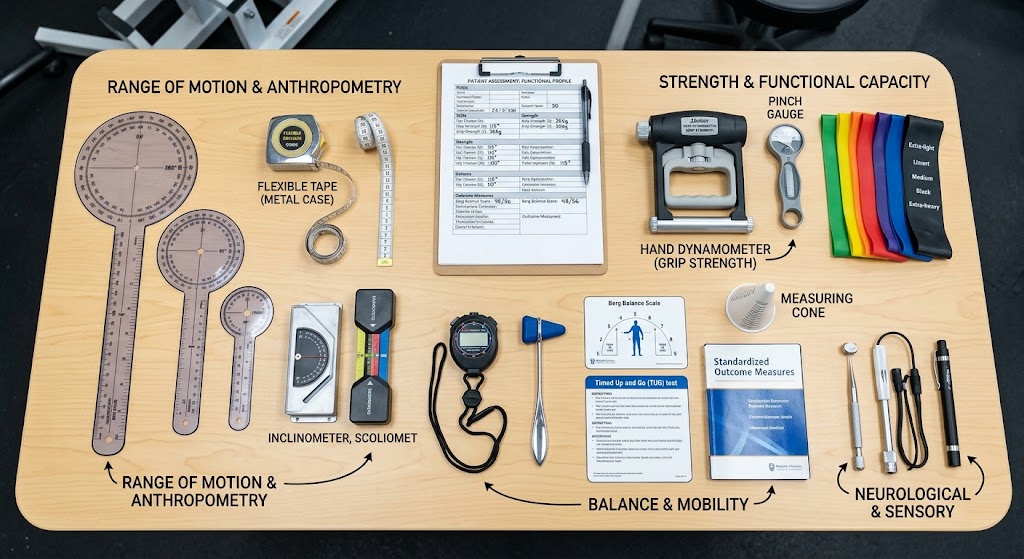
Strength: Muscle strength may be assessed using clinical strength testing or other appropriate measurement methods. The therapist compares the findings with the patient's functional needs and the demands of specific activities.
Gait and mobility: Gait assessment looks at how a person walks. The therapist may observe walking speed, step pattern, balance, use of assistive devices, and the ability to move safely through different environments.
Daily function: Physical therapy assessment should connect physical findings with real-life activities. These questions help move the assessment from isolated body measurements toward meaningful function.
How Physical Therapy Goals Are Set
 Once the assessment is complete, the therapist and patient can identify what they want rehabilitation to achieve.
Goals should be based on the assessment findings, the person's priorities, and what is realistically achievable. The APTA recommends that goals be functional, measurable, and time-limited, and that they be developed collaboratively with the patient or client.
Once the assessment is complete, the therapist and patient can identify what they want rehabilitation to achieve.
Goals should be based on the assessment findings, the person's priorities, and what is realistically achievable. The APTA recommends that goals be functional, measurable, and time-limited, and that they be developed collaboratively with the patient or client.
From measurements to meaningful goals
 A useful goal explains not only what physical change is expected, but also why that change matters to the patient.
For example, instead of simply writing: Improve knee range of motion, a more functional goal might be: Improve knee flexion sufficiently to allow the patient to climb stairs more comfortably within four weeks. The exact target will depend on the individual's condition, baseline assessment, prognosis, and functional requirements.
The World Health Organization's International Classification of Functioning, Disability and Health (ICF) provides a framework for considering body functions, activities, participation, and environmental factors when describing functioning.
A good rehabilitation goal connects a measurable physical change with something meaningful in the person's everyday life.
A useful goal explains not only what physical change is expected, but also why that change matters to the patient.
For example, instead of simply writing: Improve knee range of motion, a more functional goal might be: Improve knee flexion sufficiently to allow the patient to climb stairs more comfortably within four weeks. The exact target will depend on the individual's condition, baseline assessment, prognosis, and functional requirements.
The World Health Organization's International Classification of Functioning, Disability and Health (ICF) provides a framework for considering body functions, activities, participation, and environmental factors when describing functioning.
A good rehabilitation goal connects a measurable physical change with something meaningful in the person's everyday life.
Goals can change during rehabilitation
 Goals are not necessarily fixed from the first appointment until discharge. They can be reviewed and modified as the patient's condition changes.
If progress is faster than expected, a goal may be advanced. If progress is slower, the therapist may adjust the timeframe or reconsider the treatment plan. The APTA notes that goals should be updated when progress or medical status changes.
Research on rehabilitation goal setting also highlights the importance of focusing on activities and participation, rather than concentrating only on impairments such as strength or range of motion.
Goals are not necessarily fixed from the first appointment until discharge. They can be reviewed and modified as the patient's condition changes.
If progress is faster than expected, a goal may be advanced. If progress is slower, the therapist may adjust the timeframe or reconsider the treatment plan. The APTA notes that goals should be updated when progress or medical status changes.
Research on rehabilitation goal setting also highlights the importance of focusing on activities and participation, rather than concentrating only on impairments such as strength or range of motion.
Key takeaways
- Assessment establishes a baseline: Range of motion, strength, gait, mobility, and functional abilities can help show where a person is starting.
- Measurements should have a functional purpose: The most useful findings are connected to activities that matter to the patient.
- Goals should be collaborative and measurable: Patients and therapists can work together to define realistic goals and review them as rehabilitation progresses.
Reminder: this article is general information, not medical advice. Check with your doctor or physical therapist before starting anything new.
Sources
- American Physical Therapy Association, Initial Examination and Evaluation, current professional guidance.
- World Health Organization, International Classification of Functioning, Disability and Health (ICF), WHO.
- Haugk et al., ICF classification of therapeutic goals for outpatient episodes of neurorehabilitation in post-stroke and Parkinson disease, Disability and Rehabilitation, 2024.
- Constand & MacDermid, Applications of the International Classification of Functioning, Disability and Health in goal-setting practices in healthcare, Disability and Rehabilitation, 2014.